Spam is love, spam is life.
Welcome to PROCESS, a ten-part series on processed food in which I discuss my favourite, much-maligned mainstays of the British shopping list. This is part one, all about Spam.

My paternal nana and grandad were as working class as it’s possible to get in deepest Lancaster. Mill workers from childhood, I remember visiting nana at work in Nisbet’s factory on North Road in the centre of town when I was very small, tubes of red and royal blue knitted sleeves spooling out of the machines, the smell of detergent and dye rising in the steam from her pressing table. She used to drink tonic water at her station, and wear a blue press-studded tabard to protect her elaborate 80s knitwear.
My nana’s kitchen is one of my fondest childhood memories. Brown and cream, it was hot with boiling potatoes in winter and open to the elements in summer, a colourful plastic strip curtain hung over the door to keep the flies out. I was under strict
The content below was originally paywalled.
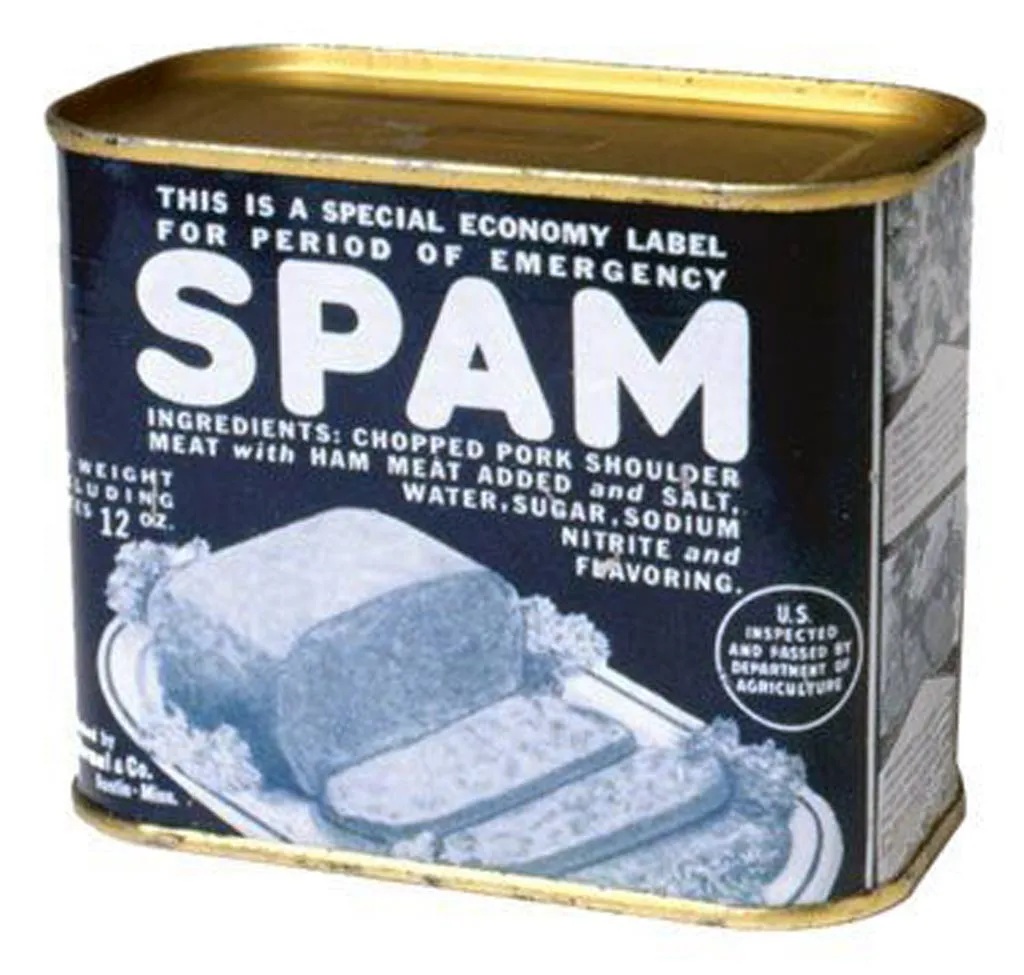
instruction every visit not to mention that I might be peckish. She would put the kettle on (I was not allowed tea or coffee,) and get the chip pan out immediately, or boil a hundred eggs, or, my favourite, let me make Spam butties. I would stand at the counter buttering lethal quantities of Flora onto round milk loaf or unstable Danish white, occasionally stopping to spoon Coffee Mate into my mouth. I would need help getting the Spam out of its tin—like corned beef, I was given many warnings about how sharp those tins were, and how few fingers I would have if I messed about with them. That iconic tin, it turns out, was designed for the meat to be packed into it raw, then cooked inside it. That’s why it’s so tightly packed. That’s how the pork pie-like jelly forms.
Salt is still my major weakness. I loved the softness of the completely nutrition-free bread my nana always had to hand, and the squidge of margarine against it. The Spam itself was a strange flavour to me, something peppery and extremely salty, more like the insides of a hot dog sausage than a slice of ham. I have never been squeamish about Spam. It’s just pork, ham, salt, sugar, potato starch, water and sodium nitrate. It is pasteurised, you know. It lasts forever. It cannot make you ill. Even now, when I’m not feeling my best, I crave Spam sandwiches as white and pink as a block of seaside nougat. They remind me that no food is truly off-limits, that I can eat what I want, when I want to. That I deserve to be comforted.
Spam came to Britain during WWII, after becoming a national staple in the US where it was invented. A bit of Spam trivia here for you—the name came before the product. It turns out that someone, an actor called Ken Daigeneau, thought Spam, a portmanteau of spiced ham he made up, was just a funny word, and that there should be a food called that. Hard agree. This word hung around in his family’s vocabulary until his brother, an executive at Hormel Foods allegedly pitched the idea of convenience pork made in a similar way to the already popular American store cupboard favourite, tinned corned beef, and they ran with it. Its portability and stability meant that Spam quickly became the go-to meat for wartime ration packs. Soldiers quickly got sick of eating it from the tin, but at home during the Great Depression, that rosy pink kinda-meat was a household saviour.
I like to think that Spam became popular in Britain not due to necessity—wartime rationing was strict but Spam was not the only meat product readily available, we also still ate tripe and had the Dig For Victory campaign that encouraged households to have their own garden chickens, remember—but because of our unparalleled, weird sense of humour. Spam is, as Ken Daigeneau knew, a funny word. And it’s a bizarre product when you think about it. For it to become embedded in popular culture enough for Monty Python to write a whole song about it, and then much later a West End musical, there was more to this meat than its utility. It’s bright, almost pop art branding and its ubiquity on grocery shop shelves was something that everyone could relate to. It was a meme. Its adverts were wild, and incredibly catchy.
Later in the 90s, electronic mail’s scourge of the technological high seas, the unsolicited cold-call of the inbox, was named Spam for this reason. It was everywhere, and it had little to no substance. Bit offensive to Spam, but clever all the same.
Spam seems to be able to take the joke. The official website is set up with lifestyle brand photography and bright, punchy design. They say “when days end with y, we end them with “mmm”.” Their merch is unbeatable. There is a Spam museum in Austin, Minnesota, with the tagline “Puts a whole new spin on cubism.” If you truly love Spam, you can become a Spambassador. “At first glance, one might assume SPAM® products are produced through magic,” They say. “But it’s actually a relatively simple, conventional process.” I am crying. This is wonderful copywriting.
Outside of Britain, Spam isn’t a joke, it’s an integral part of local cuisine. In Hawaii, Spam was brought over by American GIs and never left, just as it was in South Korea, which happens to be the world’s second largest consumer of Spam. An invasive pork product? Maybe. But Anne Kondo Corum’s “Hawaii’s Spam Cookbook” first published in the mid 1980s remains a bestseller throughout the island state, showing the prevailing popularity of Spam 2000 miles away from mainland USA. This wonderful book also has recipes for Hawaii’s other tinned favourites too—sardines, corned beef and vienna sausages. Their popularity makes sense. They are convenient, they are shelf stable, they are cheap, and they have long expiration dates, which is all very important to isolated and hard to reach communities, especially if food has to be shipped or flown in at great expense. Hawaii is one of America’s most poverty-stricken states thanks to high cost of living and low rates of pay. Is it any wonder that Spam continues to have the nation in a chokehold?
Take a look at some of the recipes and you’ll see Hawaii’s culture reflected in the preparation of each dish. Spam Musubi combines Japanese techniques with the product: a slice of SPAM is sandwiched around a layer or between layers of rice and sesame seeds and wrapped in seaweed. It’s a form of sushi. Papakolea Hawaiian Goulash combines Spam and corned beef in a stew form, which is served atop a steaming bowl of rice. Spam Manapua or mea’ono-pua’a is a type of dumpling or bao-type bun with a spam and cabbage filling. Delicious!
What’s more, there are varieties of Spam in Hawaii, the Philippines and South Korea you can’t get elsewhere, such as Teriyaki, Jalapeno (!!!), and Tocino, a type of Spanish bacon that’s super popular in the Philippines. For homestyle American diner vibes, there are maple and hickory smoked varieties. I would gladly taste test them all for you if I could get hold of some.
What I think is important about Spam is that it represents everything that people hate about processed food, but yet it endures. There is nothing natural about it, neither in form or presentation, and still it is loved by millions all over the globe. While it’s not cheap in Britain anymore (please tell me, what food is actually cheap here in 2023? I bought a white cabbage for a pound the other day, A POUND) it’s still a lingering part of our food heritage, a food that reminds us of chippy teas, school dinners, and our grandparents. I’m not calling for a renewal of our interest in tinned meats, I’m just asking to give Spam its dues. It is what it is, and nothing else. It still does exactly what it set out to do back in the 1920s. And it still goes hard when fried and paired with egg and chips.