
Peanut butter for winners.
At school, I was shocked and amazed to learn that French children regularly had chocolate for breakfast. Not the vague approximation of chocolate that coated my Cocopops or that whispered on the breeze alongside my Weetos, but actual, factual squares of chocolate, often in a folded piece of bread like a forbidden sandwich. Needless to say I was immediately enamoured with the strange and exotic country over the channel—a world of class and taste quite outside my range of comprehension. I went home and told my family of my findings. It was agreed that I could, occasionally, have Nutella on toast for breakfast (or whatever the supermarket equivalent might have been at that time.) Hypercool!
The content below was originally paywalled.
Now I’m older and I realise that France is indeed a country of sophistication, culture and intrigue for many other reasons, but the idea of chocolate for breakfast still excites me. These chic French people were all once petit children, scoffing Nutella butties and squares of Ritter Sport as they run out to get to school on time. Lady with a Marlborough Gold and a messy bob hairdo—I know you love Nutella. It makes me think you’re even cooler.
Nutella is occasionally in the news, and by that I mean the same old posts return to Instagram’s trending page, because of its negligible nutritional content. My favourite sorts of posts are those which “reveal!” an “unknown!” scandal about a product—usually a food in my case, probably because the algorithm knows I love to eat. The best one IMO is the picture of Nutella’s ingredients. Thank you, online investigative journalist! We thought instead it was full of chia seeds and IBS green juice!! I guess we could have looked at the label and learned exactly the same information, but where’s the fun in that?
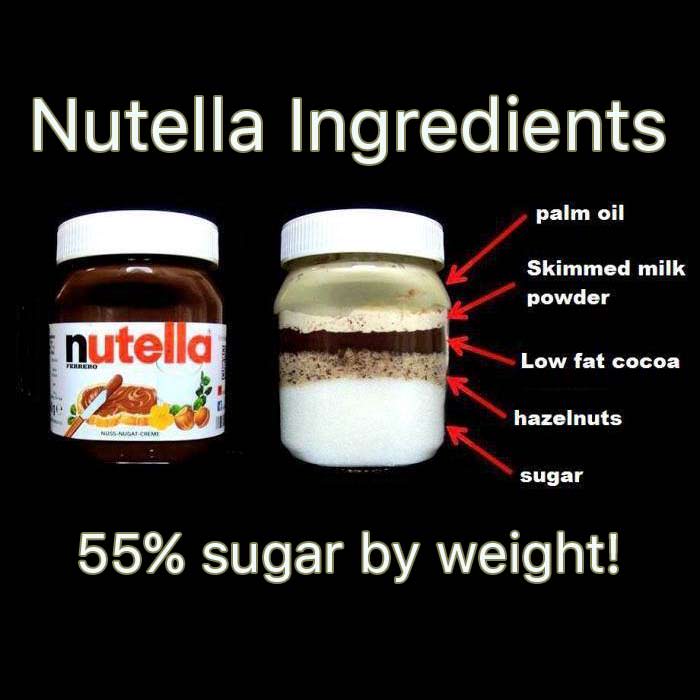
As you can see, Nutella is not a health food. It is a highly-processed snack food product made from palm oil, lots of white sugar, and powdered milk, all three of which are ultra-processed ingredients themselves. It’s not a great option if you’re trying to eat food that’s actually food. This is, arguably, what makes it delicious. Bear in mind, I also like that macaroni cheese that comes in boxes and cook with corn oil even though I know it’s worse for me than drinking diesel. Probably. What I wasn’t happy about is the use of palm oil, which contributes to deforestation and loss of habitats for hundreds of species. I’m happy to eat processed foods. I’m not happy about buying products that destroy the environment. This sentiment was shared by thousands upon thousands of commenters, who were disgusted to realise they’d been consuming a product they believed to be damaging to the planet and to their bodies. I especially liked the posts where calorific content was shared, as though that wasn’t already on a sticker on the very top of the lid of every jar.
Ferrero have a whole section of their website dedicated to discussing the problems with the palm oil in Nutella and their efforts to improve how it’s harvested and treated. They claim that “100% of our palm oil can be traced back to the mills, guaranteeing that it does not come from plantations subject to deforestation” However, their cocoa is Rainforest Alliance accredited—a programme that is notoriously under-enforced.
I am extremely pro-eating whatever food takes your fancy, but sometimes it’s important to look at its provenance. Maybe the problem isn’t where you thought it might be. Avoiding palm oil was something I did until I realised there were other issues to concern myself with—things like child slavery in the cocoa industry, still a problem today despite programmes such as the Rainforest Alliance. I had no idea there were initiatives like the Earthworm Foundation for companies like Ferrero to work with, to promote and support environmental regeneration in agriculture across the world until I looked at Nutella’s Hazelnut Charter (yes, there is one, and it’s incredibly thorough.) There are endless projects aimed at human welfare, animal welfare, nature preservation, regeneration, healthier living, and sustainability. Often they are used as a plaster to market unfavourable products. It’s up to us as consumers to choose what we believe, and what we support.
I guess what I’m saying is, maybe it’s not about the calorie content of the processed palm oil you’re putting into your body. Maybe there are bigger problems in the food industry than that.