
What’s a copywriter?

They say no question is a stupid question. While that may be true, asking me to look over your work to see whether any of it is infringing on anyone’s registered trademarks might just be a little… ill-advised.

That’s because I’m not into the whole copyright law game – I’m a copywriter.  And yes, that’s confusing. And yes, that mistake is a common one. I’m sorry, I don’t know how to make sure your song lyrics don’t get ripped off. I could help you perfect them, though.

A copywriter is someone who uses written content to convince a reader to take action. I usually say my daily job is around 60% writing and 40% staring into space thinking of better ways to say the sentence I just wrote. That’s because it’s my job to put across specific messages, with very specific keywords, using a very specific tone. It’s all very precise.

That’s not to say it’s lacking in creativity. I get to be creative – just within set parameters. That’s the challenge and the fun of it.

We love words

Copywriters love words. Personally, I can’t get enough of those things. That’s why on top of my day job as a freelance creative copywriter, I’m a freelance features writer, I have four separate blogs (and counting), I’m writing a book, I try out poetry every week (to varying degrees of success) and I read everything I can get my hands on.

Copywriters are known for their in-built empathy for language – not just writing it, but hearing it and understanding it. We know how a sentence will read, but we also understand that that small collection of words will feel different to a reader, depending on the order we place them, or the choice of synonyms we use.

When you hire a copywriter, you’re not just getting a typist. You’re asking a word fanatic to complete your work for you. If it’s words you want, you’ve come to the right place.

We’re good at metadata (but might not love it all that much)

But who does? A copywriter’s strengths are in writing (obviously), creativity and planning content using a range of tools such as SEO keyword research.

We’re also pretty good at sprucing up your product descriptions and inputting back-end metadata thanks to our skills in accuracy and a need to make even the dullest content shine. Like clearing out those fatbergs deep below the city, metadata’s a tough job, but somebody’s got to do it. Let us plug in our headphones and get on with it.

We can proofread and edit

So you think your content’s perfect do you? Dare to place a bet on that?

Copywriters have an inbuilt skill – a hidden superpower, if you will – that enables us to strike down a grammatical faux pas at 100 yards. If you’re looking for somebody to go over an 180 page document to check readability and accuracy, hire a copywriter.

We have industry skills and knowledge too

When you’re looking at hiring a freelance copywriter, ask them what industries and sectors they’re experienced in. You’ll be surprised.

Personally, I could write 50+ blog posts each on Further Education, Apprenticeships, upskilling (in engineering, digital and construction), wastewater storage and anaerobic digestion, the wedding industry, the beer industry, food and drink, diversifying within the farming industry, digital marketing, corporate travel… and that’s just the sectors I’ve been working in recently.

Copywriters are a mine of information on your competitors as well as your own industry. The good ones do their homework before they meet with you. Use that geeky knowledge to your advantage.

If you’d like to talk a bit more about what a copywriter is, or you’d like to have a chat about what I could do for your business’ copy and content, contact me and let’s set up a meeting asap.


Freelancers are good for your health

freelance copywriters are good for your health

Did you know that freelancers are good for your health?

Not only are they proven to reduce stress, they’re also great at improving staff morale and office dynamics, and that’s before we start getting into all the positive motivational impact they can provide.

Here are the reasons we’re so good for you.

We’re infectiously enthusiastic

The thing about freelancers is, we love what we do. That’s why we’ve decided to devote all of our time to our careers, focusing intensely on one particular talent we know we’re a leader in. For me, that’s writing. For others, it’s web dev, or design.

No matter our niche, you can guarantee that we’re more enthusiastic about it than you could possibly imagine, and that we are excellent at what we do. That’s our job. To be great. The side-effects of this in your staff might include renewed excitement and positivity.

We take a load off your shoulders

That blog post you know you should be writing? Consider it done. Scheduling this week’s social media posts slipped down your to-do list again? Take a deep breath and cross it off completely. The buggy little fixes on your company site you keep meaning to get round to? Bibbity, bobbity, boo.

Us freelancers relish the challenge of getting down to work on a tight deadline. What looms in the shadows to you is a sparkling opportunity to us. Don’t sit there stressing over work you’ll honestly never get around to doing – just pass it on to a pro, wipe that forehead and feel the sweet chill of a job well done.

We’re life-givingly honest

If we don’t think we can hit a deadline, we’ll tell you. If you’re asking us to work on something that’s not our forté, you’d better know we’re working extra hard to get it right because otherwise we’d tell you about our limitations.

We don’t work for your company; you’re hiring our services. That means when we come in and sit opposite you, we’re going to be straight with you. We already have the job, we have nothing more to gain from blagging at this point. We’re often refreshingly blunt too – especially if you’ve asked us to critique your work or run an audit. Not having emotional ties gives us the freedom to say exactly what we think and you’d be surprised how much life that can give you.

We motivate you to look at your own deadlines

If you’re giving us work you need a quick turnaround on, we’re going to email to request amends and feedback. Sorry about it. We want to make sure the work you’ve tasked us with hits the deadline right, and suits the brief well, so it’s on us to make sure we can get the job done correctly.

That doesn’t mean we’ll be bothering you though. Freelancers are self-sufficient geniuses who can work away to a brief without any further intervention. All we’ll get in touch about is fact-checking and deadlines.  Listen: That’s the sound of peace and quiet. Now there’s no excuse. Time to crack on with your other priorities.

Think you could use the soothing effects of a freelance content creator and copywriter? Get in touch and let’s talk about what I can do this week, right now, to make everything better.

A glorious future where we can ignore our customers

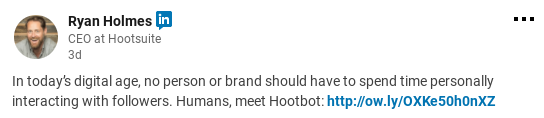
I’m not sure if it’s just me, but this LinkedIn update gave me the heebie jeebies.

I think it’s the use of the words “should have to.” It implies, pretty directly, that interacting with your followers is a chore. Using Hootsuite, the social media management tool that Ryan Holmes is the CEO of, makes it a lot easier to interact with those pesky followers. You can plan and schedule and set up all manner of time-saving tricks to ensure that your time spent with the people talking to you is kept to a minimum.

What I want to ask is – why are you doing that? Why do you hate your customers so much?

People like to interact with the brands and companies they use. Whether it’s to confess their love (Yorkshire Tea’s Twitter account is a good example of this) or to complain (Southern Rail) these interactions make them feel empowered. It’s important to consumers to keep in direct touch with the things they use every day. People feel the need to talk to everyone about what they’re doing, what they’re using and how they feel about it. That’s not the Millennial effect. We did that.

Businesses and brands have spent the past 30 years developing advertising that doesn’t just instruct, but encourages a feeling of loyalty. The idea that an individual would buy a cup of coffee not for the contents but because they want to be a part of something bigger (Starbucks Pumpkin Spice every damn year) is a sales and marketing dream come true.  Fostering that warm and fuzzy feeling of togetherness means answering a few Tweets, offering a couple of competitions and replying to any complaints. That’s the price you pay.

Why would a consumer use social media to talk to a brand?

  1. To make a visible complaint (empowerment)
  2. To talk about how much they love the brand (loyalty)
  3. To join in or add to a conversation (being a part of something)
  4. It’s how they communicate (convenience)
  5. To make a smartass comment in front of “everybody” (also empowerment, but a bit of fun too)

If you have never talked to a brand on social media yourself, try to think about a situation that would encourage you to do so. For most people who don’t use social media regularly, it’s to make a complaint.

Imagine you spent the time thinking of the best way to complain to a company who you believe have made a mistake. You’ve found their Twitter handle and you’ve hit the word count dead on. Everyone is going to see how mad you are and they’re going to apologise. You’ll feel better, and maybe they’ll take the time to improve their services in the future for other customers.

Now imagine you ‘send tweet’ and an automated response comes back to you. It tells you that your concern is important to them and that in 18-24 hours you’ll receive a full response. Or, it offers you a discount code and hopes you have a nice day. How does that make you feel?

Social media isn’t about fire-fighting – or at least it shouldn’t be. A well-cultivated social media account is a place where your customers feel listened to, and where you initiate the conversation. You might get complaints – in fact you almost definitely will – but with a decent social media plan behind you, your company or brand will be able to cope well with that situation.

Social media isn’t an inconvenience. It has become integral to most people’s everyday lives, and to treat it as peripheral means losing out on valuable consumer feedback and customer retention. Using automated services may save time, but they will never be the same as a proper representation of who you are – they will never be a trained employee able to give quickfire responses, start conversations on a whim or turn a negative conversation into a sale.

If talking to your customers is a job your organisation feels it can’t spare the time for, it might be time for a re-structure – or at the very least, some social media training.

Thank goodness then, that this was posted on April 1st. This whole thing was a Hootsuite joke, aimed at making the exact same points I made above. If you’re still wondering whether AI chatbots could help your business, hire a social media Apprentice instead, or ask me to come in and talk to your team about why it’s so important.

Do you have a content problem?

Seed Copywriting ott goldfish metaphor

When you’re busy achieving deadlines and gaining new business, it’s easy to let your content slip.

When was the last time you read your website content? I don’t mean glanced at the homepage to check the advertising banners were up to date. I mean really took the time to read it, from a customer’s point of view, to see what other people see when they find you. It’s often an illuminating experience.

In industry, we know that our website is our shopfront, where customers and clients pass by to check out our wares (and judge us by their exacting standards.)  We know that the icons need to be aligned, events need to be current, that the logos need to be visible and that the imagery needs to be relevant and non-stocky. But what about the words?

According to the Telegraph, Time Magazine and the New York Times, attention spans are getting shorter. Our goldfish-like brains are being rewired by social media, demanding shorter, zippier gulps of content that give us the information we need before we float off in search of the next nibble that comes our way. Our eyes are wide and ready to absorb information on the go, and we have neither the time or the inclination to dig deeper into the detail.

Seed Copywriting web content

Except, that’s not strictly true. As with most surveys and studies carried out with the general public, it’s extremely simplistic and glosses over a number of factors. Generalising a phenomenon, especially involving real people misses out the importance of the individual.  In an article for the BBC, Psychology lecturer at the Open University Dr Gemma Briggs had this to say:

“The idea of an average attention-span is pretty meaningless. How we apply our attention to different tasks depends very much about what the individual brings to that situation.”

Essentially – attention-span is a unique asset to each and every person visiting your website. For some, a quick blast of information is all they want and expect. For others, a deeper dive is something they need to begin to build trust with your company. This is where interesting, relevant, appropriately-pitched content is essential. That one person who wants to read more, see more, watch more could be the most engaged visitor you had that day. If your analytics are showing high bounce rates and low click-throughs, it might not be about your customers’ attention-span issues. It might also be about yours.

What Dr Briggs is not suggesting here is that every page on your website needs to be thousands of words worth of analysis and longread opinion. She’s gently pointing out that variety is the spice of life. By taking more care over your pages, your website can become an environment packed with diverse levels of content and interest to attract and retain all manner of visitors. To labour the metaphor – a reef, rather than a glass bowl.

You might not have the time to do this – but this is my job and I love doing it. Let’s have a chat about how we can create more valuable content for your visitors together. Let me care about your words!

Become one of the first businesses in Lancashire to work with Seed Copywriting

We’re here!

Seed copywriting is a brand new content marketing agency set up by me, Katie Taylor.  Before now, I’ve been working as an integral member of the marketing team at Burnley College Sixth Form Centre, Adult Learning at Burnley College, UCLan Burnley and Themis Apprenticeships and Training for four years – and in the music industry, food and drink and technology sectors before this. I have a degree in journalism, and nothing makes me happier than writing.

My brand of content marketing sees client needs and company values taking centre stage, with a strong emphasis on tone of voice and customer engagement. Find out exactly what Seed can offer – visit the Services page for more.

If this sounds like the refreshing antidote to stale, automated marketing that you’ve been looking for, why not send me an email? You could wind up being one of the first businesses (or individuals) in Lancashire to work with Seed Copywriting to refresh, tweak or even completely overhaul your marketing. How exciting is that?

Email me – I’m friendly, I promise: katie@seedcopywriting.co.uk 

This is me, at home working on my own web content with a hot water bottle.