PROCESS 09: Breakfast Cereal

Give us this day our daily Weetos

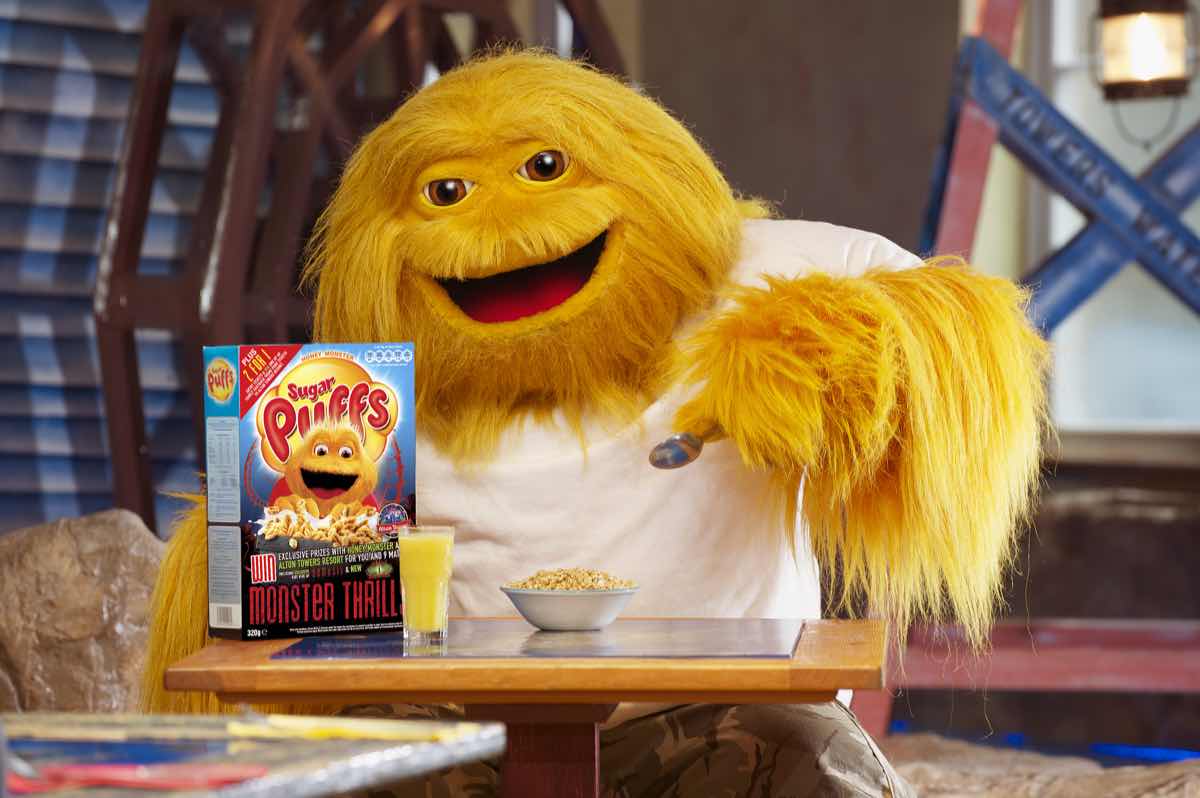
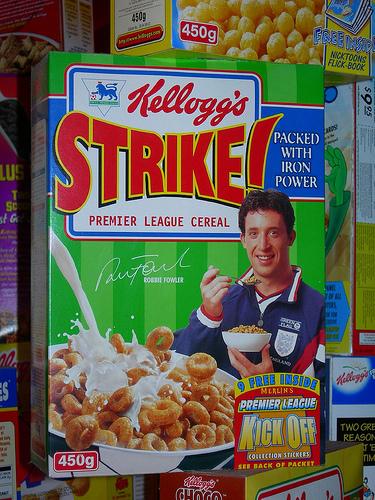
Like every child of the 90s, I grew up eating cereal for breakfast every morning. My favourites were Coco Pops, Weetos, and controversially, Apricot Wheats. My most hated adversary was the Honey Monster. His puffed wheat cereal was disgusting in both taste and texture. A truly vile invention from the writhing depths of hell.

The content below was originally paywalled.

I don’t eat cereal now. As much as I love extremely expensive muesli—the more Brazil nuts in it the better—my morning cravings are generally savoury. I love eggs and toast, shakshuka is a gift, and sausages are much better than bacon, in my opinion. I believe the sausage and egg McMuffin is a truly angelic creation, fit to cure all ills and revive a person from near-death. The nearest I get to cereal these days are the amazing apple and cinnamon porridge bars you can get from Lidl. They are essential camping and walking snacks.

I’m sure you’re all aware of the legends that claim to explain the true motives behind the invention of cereal. If not, here’s Snopes’ concise and helpful guide to the creation of Kellogg’s Cornflakes.

What’s True

The creation of corn flakes was part of John H. Kellogg’s broader advocacy for a plain, bland diet. Without referring to corn flakes in particular, Kellogg elsewhere recommended a plain, bland diet as one of several methods to discourage masturbation.

What’s False

According to the available evidence, corn flakes were primarily created as an easy-to-digest, pre-prepared and healthy breakfast food, in particular for patients at the Kellogg sanatorium in Michigan. The product was never advertised as an “anti-masturbatory morning meal.”

Corn flakes were originally recommended as an easily-digested food for people with digestive problems and other illnesses that caused nausea and sickness such as dyspepsia. Later, Kellogg fought with his brother about additional ingredients to increase the popularity of their corn flakes and rice krispies—John stuck to his principles of plain food, and Will wanted to add sugar. John saw sugar as an evil to be eliminated from our diets, along with spices, alcohol, condiments, pickles, and basically everything in the world that makes food worth eating. The point of cereal, for John Kellogg, was its “pure” and “unstimulating” nourishment.

I’m sure that he’d find Cinnamon Grahams an affront to all that is good. Imagine presenting him with a bowl of Jolly Rancher-coloured Froot Loops, made by his own corporation. And that’s what’s interesting about breakfast cereals—they quickly moved away from being promoted as a healthy, lighter alternative to starchy and friend breakfast foods, appealing to children and the young at heart with sweetshop flavours and bright packaging. The turning point happened after World War II, in part because women were entering the workforce and quicker alternatives to cooked breakfasts were needed to feed the whole family. Onwards into the 1950s, cereal became one of the advertising industry’s most lucrative and successful project. Characters were invented and printed on the box, later taking part in TV shows about their exploits. Cereals began to be enriched with additional vitamins lost during the processing of the grains—many cereals are still made using refining techniques to remove fibre, because at the time they were invented, it was thought to inhibit the digestive system’s ability to absorb nutrients.

This addition of vitamins (remember, they largely just replace vitamins lost during processing) was a huge marketing drive, not just to get families to eat more cereal, but to encourage the idea that breakfast was the most important meal of the day. To this day, there is a lingering feeling that to miss breakfast is to ruin your day before you’ve even begun it. According to a recent study, it’s not true. Eating food, whatever time of day, is what keeps you going and strengthens your body. Your gut has no idea what time of day it is.

“We found that breakfast is not the most important time of the day to eat, even though that belief is really entrenched in our society and around the world…if you eat breakfast and it suits you, then you shouldn’t change. But what we tend to see is that there’s a strong push towards eating breakfast because ‘you should’. The evidence now says that’s not the case.

— Professor Flavia Cicuttini1

So why are cereals so popular in a world where we seem to want more “real” foods than ever before? Is it because granola, the good-natured hippy of the cereal world has created a sort-of halo effect? Do we buy into the idea of added vitamins? I think, more likely, it’s a combination of convenience and comfort, just like most of our everyday purchases at the supermarket. Packaged cereals were invented to solve the problem of needing something easy and nutrition to eat for breakfast. They still serve that purpose, over 100 years later. It’s been 70 years since sugary cereals invented for kids flooded the market, which means your grandparents might still enjoy a bowl for nostalgia’s sake. They’ve been touted as diet tools to keep slim, and now, in 2024, there are cereals manufactured to bump up protein content rather than B12 and riboflavin, promoted as a fun and delicious way to at healthily. Cereals are not going anywhere. They are part of our diets because we want them to be, not because they need to be. And that’s the processed food industry’s biggest achievement.

1

Sievert, K., Hussain, S.M., Page, M.J., Wang, Y., Hughes, H.J., Malek, M. and Cicuttini, F.M. (2019). Effect of breakfast on weight and energy intake: systematic review and meta-analysis of randomised controlled trials. BMJ, [online] 364(142), p.l42. doi:https://doi.org/10.1136/bmj.l42

When I say I want to go to the pub, what do I mean?

What exactly am I looking for?

My favourite thing in the world is going to an old pub for a pint. I love sitting in the peace of a bar room softly buzzing with the chit chat of locals and fellow drinkers, basking in the atmosphere of a place that’s been a second living room for generations of people.

I spend a lot of time researching places to visit. I live in a part of England that’s seemingly blessed with quaint old pubs, and yet there are so few of them that really fit my elusive parameters—so few of them boast every aspect I need to call them perfect. I thought it was about time I tried to consolidate these requirements of mine, to try and put into words what it is I’m looking for, to see if what I’m after isn’t just me wishing for the Moon Under Water. I travel quite far for a good pub, so I try and make sure I’m not wasting diesel. Imagine driving two hours around the winding roads of North Yorkshire to find you’ve arrived at a total dud.

When I’m searching for pubs to visit, the first thing that puts me off are renovations. So many beautiful country pubs in the Ribble Valley have had their character stripped in favour of light oak tables and pastel tartan. What keeps me interested are original beams, wonky floors, and horse brasses—or big, clichéd bunches of dried hops and age-tinted maps on the walls. Keep talking.

If reviews talk about “decent pub grub” I am likely to wonder about the price, quality, and selection of the beer. My next step is to check photos of their bar to see what they sell. Nine times out of ten, my suspicions about Pedigree and/or Doom Bar are confirmed.

Conversely, if a country pub has stunning reviews for its food, that pub is going to be hellishly busy, it will require a reservation, and it is not what I’m looking for. I will probably book to go for my tea sometime. I don’t want to have a pint there, because it’s a restaurant. I’ll feel like I’m taking up space, and I’ll overhear someone talking about struggling to fill their holiday lets.

When I get there, I want to feel comfortable and welcome, but left alone. I want a delicious pint of beer and plenty of fun trinkets to look at on the walls and shelves. I want to feel like I’m sat reading or playing cards just like a patron 150 years ago might have done in my spot.

I want to be chatted to when I go to the bar to choose from good selection of beer, and feel like the people who work here are looked after and enjoy being there. I love a real fire, but controversially, it’s not a dealbreaker. I do, however, award huge bonus points for hauntings, witch marks, and fascinating or gory local history that can be linked to the pub—however tentatively. Points are deducted for tourism-baiting, although I’m not too harsh on this right now. It’s a difficult industry out there. Beautiful views from the windows are a tick. Funny or interesting regulars are a tick. Classic bar snacks are a massive tick—pickled eggs, butties wrapped in clingfilm, or pies from a local butchers’ shop all tot the points right up.

I want a pint that’s so good I get two more of the same. I want to feel my shoulders relax and my cheeks ache with smiling—I want to feel happy. I want to be slightly sad when it’s time to leave.

Other Stuff

My Stuff

  • I’m writing a lot more for Ferment these days, so if you get Glug or Ferment magazines, you’ll see more of me in both.

  • My series of newsletters about processed food, PROCESS is coming into its penultimate week. Upgrade to a paid subscription to read the whole series so far and to be among the first to see what’s coming next.

  • I’m working on a lot more of my own work, which doesn’t bring me in any money. This is not ideal. If you have writing work you’d love to send my way, please get in touch!

    Country Pub – Philip Juras

    Katie Mather’s The Gulp is a reader-supported publication. To receive new posts and support my work, consider becoming a free or paid subscriber.

PROCESS 08: Plant M*lk

Why do we drink milk anyway?

I was 20 when I discovered Alpro. I was a fiend for milkshakes in my early 20s, especially those which tasted nothing like banana but were marketed as such, and Alpro’s perfectly fit the bill. Soon after that, I moved in with a bunch of vegetarians, one of whom often drank soy or rice milk instead of the semi-skimmed I was so used to seeing in the fridge.

My first thought was how exciting it was to have something unusual in the kitchen. Milk is unthought about. It is a thoughtless purchase. It is always needed. Milk, bread, toilet roll. I never stopped to think about how much of it I drank on a weekly basis, and only vaguely considered it strange that every single person I knew went though litres of it at a time whenever their recycling really needed taking out to the wheelie bin.

The content below was originally paywalled.

Milk is, of course, a useful and renewable way to consume calories and nutrients, and we as a race have been drinking the milk of cows, goats, sheep, yak, buffalo, reindeer, and donkeys since 9000 BCE, and cultivating dairy farms for around 6,000 years—about the same length of time that we’ve been making and drinking beer. Drinking your nutrition is super efficient, and since human breast milk is quite hard to come by (and not that fatty, really) and cows produce a lot and happen to be docile when domesticated, it supposedly makes sense that early humans decided to give their milk a go. If you had meagre supplies and you didn’t want to kill your animal for a week’s worth of food, milk might have been the difference between starvation and survival.

In the 21st century, we don’t need to rely on animals for nutrition. It’s entirely possible to live healthily without any animal products whatsoever. In terms of animal liberation, the commercial dairy industry is as detrimental to animal welfare as farming for meat—the animals are still kept, farmed, and taken from their mothers, they are slaughtered when they are no use as dairy cattle, and they live entirely at the mercy of human consumption. They exist in their current breeds for their utility to mankind. If you consume dairy in any form, as I do, I believe it’s important not to be blind to these facts. Just because there is no blood, doesn’t mean it is guilt-free. We are removed from the suffering only in as much as the products—cheese, cream, yoghurt, protein powders—are unrecognisable as animal in nature. In reality, they are as brutal as a carcass.

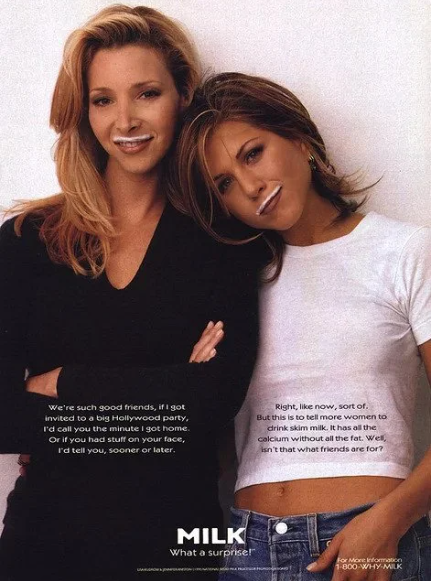
In the 20th century, milk drinking reached wild levels of obsessive consumption. In the 1950s, it was a vessel on which newly-developed breakfast cereals could sail towards total breakfast table domination (don’t worry, I’m coming for them soon.) It was seen as a cure-all for strong bones and healthy muscles, and became a marketing campaign all its own—a product that wasn’t branded, being promoted as if it was. I never cared about whether the milk I had at home was from Arla or Müller, just that it was there in a massive 6 pint carton and that I should drink more of it if I wanted to be a healthy, smiling child, or as beautiful as Phoebe and Rachel from Friends.

I always wondered why my tummy hurt when I drank a glass of milk. Turns out, most of us aren’t that good at digesting it. And that’s where the non-animal liberation-centric arguments in favour of Plant M*lk begin.

Approximately 65% of the population can’t properly digest dairy without some form of reaction. Until I started using plant milk in my brews I had no idea I was one of them. I’m only slightly intolerant, I can maybe have a cappuccino and forget to ask for oat milk, but I can’t eat normal yoghurt (for some reason I can eat Fage, someone tell me why) and I definitely can’t drink a glass of it. I don’t know why anyone would. Ming.

I started drinking soy milk because it lasted longer and nobody stole it out of the fridge at work, and now I have oat milk delivered to my door by my local milkwoman. I never need to drink dairy milk again. As I happily shake my glass bottles each morning to re-combine the totally separated oat milk solution and the slightly yellow rapeseed oil suspension before I make my breakfast, it occurs to me that I believe my beloved Oato is healthier for me than cow’s milk, but I can actually see the component parts of it. It is totally processed.

Oato is a British Oat milk company (from Lancashire, actually 💅) that uses British oats, water, British rapeseed oil, British salt, and various nutrients like B-vitamins and calcium to make a milk-like drink suitable for someone like me—someone who likes creamy coffees but who can’t stand the taste of dairy milk now they’ve not had it in years (isn’t that odd?) It’s creamy because of the rapeseed oil, which mimics the saturated fatty acids in dairy milk. Neither are great for you. My oat milk, just like all other plant milk, needs to have vitamins added to it, which is why I don’t make my own. Dairy milk has naturally-occurring D and A vitamins as well as calcium, but when the milk is processed to reduce the fat content, there is fewer nutrition. If you drink skimmed milk, I don’t know why you bother. There is nothing in it of value. Stop living in the 90s. Fat is not going to kill you on the spot. You are free.

The reason I prefer oat milk over every other option now available to me is down to how it impacts the environment. I can have a locally-made product delivered directly to my door. At this point, that’s even more environmentally sound than super-local independent dairy milk. I don’t choose soy milk because unless it’s organic and grown in the US or Canada, it might be contributing to rainforest deforestation, and I don’t choose almond milk because of immense water consumption in dry areas of the world. Coconut milk has a reputation for exploitation, although there are many sustainable enterprises growing in South East Asia hoping to curb this. Hazelnut milk is a pretty sustainable option, actually, but it’s also on the expensive side. There’s no getting around it though, whichever you choose, it’s all highly processed. So we come back around to that difficult question—is processed food inherently worse for you than natural food? And, if the natural food in question has been heat-treated, homogenised, filtered, and had vitamins added to it, at what stage does it stop being all-natural?

Perhaps that’s why there are farms near me making a killing selling unpasteurised raw milk. People are so scared of processed food they’ll run the gauntlet with literal E. Coli. Which, I suppose, is a truly natural pathogen.

PROCESS 07: Nutella

Peanut butter for winners.

At school, I was shocked and amazed to learn that French children regularly had chocolate for breakfast. Not the vague approximation of chocolate that coated my Cocopops or that whispered on the breeze alongside my Weetos, but actual, factual squares of chocolate, often in a folded piece of bread like a forbidden sandwich. Needless to say I was immediately enamoured with the strange and exotic country over the channel—a world of class and taste quite outside my range of comprehension. I went home and told my family of my findings. It was agreed that I could, occasionally, have Nutella on toast for breakfast (or whatever the supermarket equivalent might have been at that time.) Hypercool!

The content below was originally paywalled.

Now I’m older and I realise that France is indeed a country of sophistication, culture and intrigue for many other reasons, but the idea of chocolate for breakfast still excites me. These chic French people were all once petit children, scoffing Nutella butties and squares of Ritter Sport as they run out to get to school on time. Lady with a Marlborough Gold and a messy bob hairdo—I know you love Nutella. It makes me think you’re even cooler.

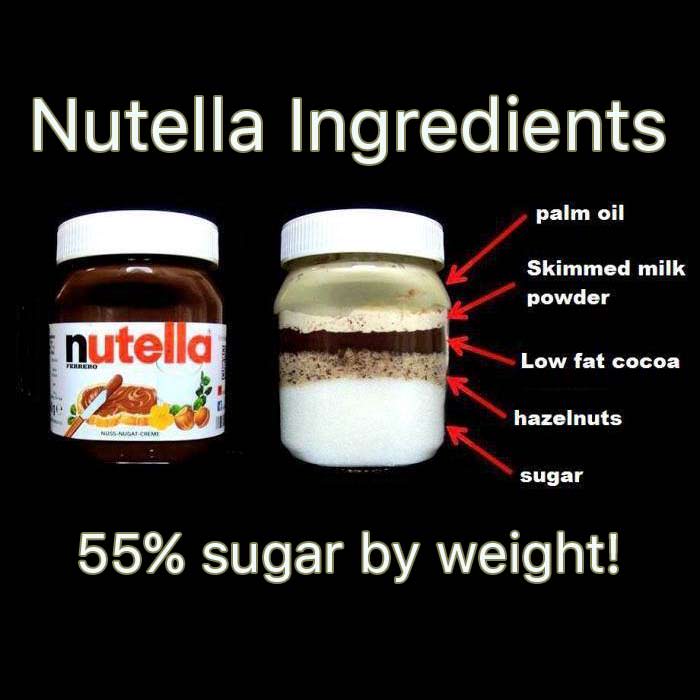
Nutella is occasionally in the news, and by that I mean the same old posts return to Instagram’s trending page, because of its negligible nutritional content. My favourite sorts of posts are those which “reveal!” an “unknown!” scandal about a product—usually a food in my case, probably because the algorithm knows I love to eat. The best one IMO is the picture of Nutella’s ingredients. Thank you, online investigative journalist! We thought instead it was full of chia seeds and IBS green juice!! I guess we could have looked at the label and learned exactly the same information, but where’s the fun in that?

As you can see, Nutella is not a health food. It is a highly-processed snack food product made from palm oil, lots of white sugar, and powdered milk, all three of which are ultra-processed ingredients themselves. It’s not a great option if you’re trying to eat food that’s actually food. This is, arguably, what makes it delicious. Bear in mind, I also like that macaroni cheese that comes in boxes and cook with corn oil even though I know it’s worse for me than drinking diesel. Probably. What I wasn’t happy about is the use of palm oil, which contributes to deforestation and loss of habitats for hundreds of species. I’m happy to eat processed foods. I’m not happy about buying products that destroy the environment. This sentiment was shared by thousands upon thousands of commenters, who were disgusted to realise they’d been consuming a product they believed to be damaging to the planet and to their bodies. I especially liked the posts where calorific content was shared, as though that wasn’t already on a sticker on the very top of the lid of every jar.

Ferrero have a whole section of their website dedicated to discussing the problems with the palm oil in Nutella and their efforts to improve how it’s harvested and treated. They claim that “100% of our palm oil can be traced back to the mills, guaranteeing that it does not come from plantations subject to deforestation” However, their cocoa is Rainforest Alliance accredited—a programme that is notoriously under-enforced.

I am extremely pro-eating whatever food takes your fancy, but sometimes it’s important to look at its provenance. Maybe the problem isn’t where you thought it might be. Avoiding palm oil was something I did until I realised there were other issues to concern myself with—things like child slavery in the cocoa industry, still a problem today despite programmes such as the Rainforest Alliance. I had no idea there were initiatives like the Earthworm Foundation for companies like Ferrero to work with, to promote and support environmental regeneration in agriculture across the world until I looked at Nutella’s Hazelnut Charter (yes, there is one, and it’s incredibly thorough.) There are endless projects aimed at human welfare, animal welfare, nature preservation, regeneration, healthier living, and sustainability. Often they are used as a plaster to market unfavourable products. It’s up to us as consumers to choose what we believe, and what we support.

I guess what I’m saying is, maybe it’s not about the calorie content of the processed palm oil you’re putting into your body. Maybe there are bigger problems in the food industry than that.

Begin again, the story of your life

— from Da Capo by Jane Hirshfield

If 2023 brought me destruction, grief, pain, and exhaustion, the first four days of 2024 have set about trying to make up for it. I’ve felt more excitement, restfulness, peace, wonder, joy, and inspiration in these weeks since Christmas than I have in a long time. I, for once, am ready to start a new year on both feet with my face defiantly turned up into the rain. I am here to be myself. I am here.

I ran for the first time in a long time today, in a normal t-shirt that got soaked through by passing showers, determined to normalise what, in my mind, had become a competitive sport I could no longer take part in. I listened to George Michael and Aretha Franklin and Sugababes as I ran. I saw blue sky in the dark clouds. I felt energy, long dormant, lighting up my chest.

One of the most important things for me this year will be my writing. Over the past three years it’s taken something of a back seat to running Corto and, latterly, dealing with various health issues (both physical and mental.) I have no split between my interests now. I am all-in for writing. My keyboard will crack in half from the hammering of its keys. My notebook collection will teeter out of control. My projects will become more adventurous, more challenging. I want to level up.

What this means, I’m not yet sure, but I know that I can feel myself reaching for more. I hope you stick around with me so we can find out together.

My Stuff

  • My first published story of 2024 is “Anon, A Giant Monster Roams — Torrside Brewery in New Mills, Derbyshire”. I’m very proud of it and if you’ve not read it yet, I’d love it if you could spare a few minutes to learn about one of my favourite breweries of all time.

  • For Hwaet! zine, I wrote a piece on witchcraft, brewsters, alewives, beer, and women’s work. You can buy the beautifully illustrated zine here.

  • A story about the terroir and the mountains of Abruzzo, for Glug. I love having a monthly column about terroir and the geology of winemaking, there is always something to learn.

Other Stuff

  • Eoghan Walsh’s eulogy for The Old Hack, a bar in the EU quarter of Brussels packed with vintage political gossip, predictions for the future of Brussels’ beer scene, and anecdotes about what it was like to drink in a pub full of EU politicians, journos, and civil servants. As always, he manages to pull at the merest hint of a story and drag endless colourful moments from it.

  • There’s never a bad time to look at collections of Ladybird book illustrations.

  • MAH played a track from Grand Theft Auto: Vice City — The Definitive Edition this morning on Radio 6 and honestly, I can’t think of a better playlist.

  • A stunning mini documentary about local (to me) fell runner Ellis Bland’s obsession with Bowland fell Shooters’ Hill

    Katie Mather’s The Gulp is a reader-supported publication. To receive new posts and support my work, consider becoming a free or paid subscriber.

    Share

PROCESS 06: HP Sauce

I prefer ketchup, but what ya gonna do?

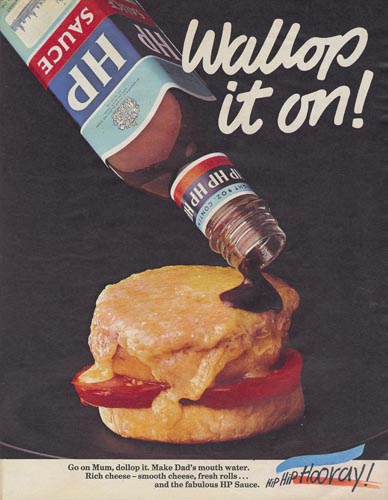
Despite being a strict own-brand household, HP Sauce always has a place in our cupboard. I’m not actually a fan, but my husband Tom won’t eat a bacon sandwich without it. He also puts it on sausage and mash—I can’t cope with sauces and mashed potato. The textures are too wrong. I once knew a girl who put ketchup in her mash and mixed it around until it was a big, pinkish mass. I didn’t go round for tea again.

I’ve always got time for foods that claim a certain dignity. HP Sauce has delusions of grandeur, don’t you think? Named after the Houses of Parliament and decorated with with Elizabeth Tower/Big Ben in pride of place on the front of the bottle, it’s been a British icon for almost 130 years. Why the Houses of Parliament? The inventor of the sauce, Frederick Gibson Garton, heard that politicians were eating it down in the Westminster canteen and thought that’d be great iconography for his product. People must have liked the government a lot more back then.

The content below was originally paywalled.

HP Sauce was actually created by a grocer and pickles maker in Nottingham. A true residual from the English Empire, according to legend his sauce was based on an Indian chutney, with ingredients like tamarind and dates sourced from South East Asia and the Middle East. Apparently he used to simmer it in a kettle at the back of his shop. A milder version is known as “Fruity HP”, the one with the green label, and that has mango in it. Like many classic English sauces it also has things like raisins and vinegar in it, but HP became more popular, despite or even because of its exotic flavours. I like the idea of middle class Victorians covering their meals with a tamarind and mango salsa packed with spices and soy sauce. It somehow turns the sepia photos in my mind into colourful vignettes.

Unfortunately for the unlucky inventor of HP Sauce, he went bankrupt trying to pay his vinegar debts (something all of us pickle fans can empathise with) and he ended up selling the whole HP brand and recipe—as well as his other inventions including Daddies sauce, for £150 to his debtors. Since then, this small-scale sauce company became a national treasure, and a staple in every kitchen throughout the 20th century. Now HP Sauce is a global brand owned by Heinz, who must now own the two biggest selling, or at least the most famous, sauces in the world—HP and Heinz Tomato Ketchup.

This buyout was a shock to the people who worked for the Aston-based HP Sauce factory, and fans of the sauce. In 2006, when Danone sold HP to Heinz, the company revealed that production would move to The Netherlands.

There was a funeral for HP Sauce at the old factory. Then a wake. Don’t believe me? Check this out. Empty HP Sauce bottled were placed into a coffin, and mourners climbed onto the factory roof to hang banners decrying the closure of the factory as a national scandal. People sang the national anthem outside the gates, and body painted themselves to look like HP labels while chained to the gates. England used to be a real country.

This fabulous story in the Birmingham Mail recounts the closure 10 years on (the piece was published in 2016) and photos of the factory’s main tower remind me of the demolition of Thwaite’s Brewery in Blackburn in 2019. Iconic local brands, built up then broken down as the tides of time and commerce rose from our Nation of high street Shopkeepers through our towns in the 20th century, then conglomerated, then left. These symbols are probably some of the most visible ways to see how our towns and our local industries have changed over the years.

The tower might have gone from Aston, but the sauce lives on. 28 million bottles of HP Sauce are sold every year, and at least half of those are used in my house. This year, a commemorative bottle has been designed and no doubt will become a collectors’ edition, with scaffolding on Elizabeth Tower, covering Big Ben’s clock face. So many metaphorical interpretations. So little time.

A Very Hoppy Christmas

A beery straight-to-Netflix Christmas film from my brain to yours.

Sydnie, our protagonist, sits at a taproom bench post-shift, white wellies and dungarees topping off her workwear look, a brown ponytail sticking out of her beige Carhartt beanie. She takes a sip of her West Coast IPA, and waits for the rest of the team to arrive to discuss the upcoming Christmas party. The wonky plastic Christmas tree by the bar drops another bauble. Decorating was never her greatest skill.

Every year, the brewery throws a community event to share out donated clothes, toiletries, and Christmas presents to the less fortunate. As well as a charity donation drive, she invites people from the local neighbourhood to stop by for food and drink, knowing that once, she was once living in poverty just half a mile away from the taproom. This year she hopes the party will be bigger and better than ever, bringing more people in from across the city, and she’s invited her friends from bigger, more famous breweries to attend to boost its profile. She’s excited about the prospect of making this event a citywide festival.

Once everybody arrives, talk moves from the beers that will be on tap and the food that’ll be served to the year ahead. The door opens and Sydnie walks over to explain that the taproom is closed. It’s the new owners, and they have a speech to make.

It’s been a slow year, and profits are not where they should be. Selling to a larger brewery co should have offered more security, but instead, it’s put Sydnie’s 10bl brewery right at the front of the executioner’s queue. With more expensive ingredients bought from local producers, and various other expenditures the other breweries in their portfolio had long since cut from their budgets, she doesn’t run a tight ship in their eyes. Rather than give her the opportunity to make cuts, they simply want her to close. Immediately.

“But what about the Christmas party?” her GM shouts. “What about the community?”

The suits don’t care. The party is money spent that they can’t afford to lose. And with that, and answering no further questions, they leave, giving the brewery just three weeks to clear up and empty the unit.

The next day, Sydnie gets a call from a local brewery owner called Brad. He has heard on the grapevine that things aren’t great, and wants to know how he can help.

“No offence, Brad, but there’s nothing you can do,” says Sydnie. “If I can’t make it work here, it’s done.”

Brad asks her to meet him for coffee and she tells him about having to cancel the community Christmas party.

“Without our yearly donations, the members of our community just wouldn’t have a Christmas,” she says.

“It’s too bad,” says Brad, drumming his tattooed fingers on the table. “I’m going to talk to as many people as I can and see what we can salvage.”

Sydnie doesn’t have much hope. Leaving the coffee shop and walking back to the brewery, she sees a shop window with a Santa Claus in it, lifting a stein up to cheers the festive season. It feels like a cruel joke.

The next couple of days are a whirlwind of activity, as Sydnie tries to organise moving out the already-donated gifts to a different location for storage and distribution, as well as finishing up her brewing schedule. Two weeks isn’t long enough to start anything new, and it’s barely long enough to complete what she’s already started. She looks sadly at her barrel project. Where will they go now? She hadn’t thought about herself until now. What will she do? Go back into lab work? This was her whole life and her dream career. How can this be happening? Walking through the city to meet a friend for a drink, she sees the beer stein Santa again, and she’s sure he winks at her.

The next day, a letter arrives at the brewery. It’s handwritten, and addressed to Sydnie.

Dear Sydnie
Please accept this gift as a thank you for all you’ve done for us over the past few years.
Yours with much love,
Firebird Brewing

Her friends at a local independent brewery had sent, not a cheque, but a USB drive, with a complete plan of how to organise the Christmas party at their place on it, complete with marketing ideas, playlists, ways she could get involved if she wanted to, and a promise to throw it for the next five years in the future too. What a load off her mind! It wasn’t going to save the brewery, but it meant that the community wasn’t going to miss out. What an incredible gift. She immediately calls the folks at Firebird to thank them, and asks them how they knew all the details to make such a thorough plan.

“Brad came over and helped us with it,” Lucy, the owner says. “It was a no-brainer. Honestly, get involved as much as you like, we don’t want to step on your toes and you can say no, but you’ve got so much to deal with right now, it’d be our pleasure to help you out and make things easier.”

The next morning before work, Sydnie walks to the beer-stein Santa again and stands in front of his sparkling window.

“What do I do?” she says out loud, as his mechanical arm lifts then drops his beer. “How do I save everyone’s jobs? What am I supposed to do?”

The door of the shop opens and a white haired and undoubtedly handsome man with small, gold-rimmed circular glasses walks out, carrying an A-board. It reads: “Mulled Wine. German Beer. Christmas Cheer.” Sydnie realised she’s never actually been in this shop before—she’d never noticed it before the Christmas display. Feeling embarrassed about being caught speaking to a mechanical Santa Claus, she turns to go.

“Wait!” says the man. She debates pretending she can’t hear him through her balaclava but then she feels a hand on her arm. “Is everything okay?”

Sydnie turns to face him and notices twinkling blue eyes with a kind crinkle, and a neatly-trimmed white moustache. Despite the snowy colour of his hair, he couldn’t be more than mid-40s. Before she can stop herself, she answers: “No. Not really. I was just talking to an animatronic fictional character.”

He smiles, and invites her into the shop. Inside, it’s a Christmas fairytale come to life. Decorated in holly and real fir trees, with traditional wooden ornaments, and fairy lights and candles on every surface, it smells like a cedar wood cabin, and cinnamon chai, and gingerbread, and marzipan. There are tables and sofas to sit at, and a mezzanine like a ski chalet with shelves of gifts and books. How could she have never noticed this place before?

She learns that his name is Klaus, and he fell in love with all things Christmas when he visited his grandparents in the Black Forest when he was a child. His dream had been to recreate that magic in the US, and when this shop came up for sale, he used part of his inheritance to set up the bar, café, and gift shop of his dreams.

“But what do you do the rest of the year?” Sydnie asks.

“I disappear,” he replies. “I go travelling.”

“All around the world,” she says. “Like Santa Claus.”

Klaus pours her a mug of mulled cherry beer, warming and spiked with orange and cloves, and she tells him more than she should about the problems at the brewery. She tells him about the community Christmas party, and she explains why she can’t figure out her next steps.

“I’m so used to working for myself,” she says, “I don’t want to go back to a big brewery team again. I love making my own beer and running a happy brew house. I love being part of the community.”

It was sad, talking through the details, because it made it real. But she was glad she had someone to talk to, even if it was a stranger.

The next weeks fly by, and as the brewery empties of its stock, it also empties of her brew family too—of course they would find new jobs, but it hurt all the same. Every goodbye was a tiny heartbreak. Then, just two days before the official closing day, it was time for the Christmas party.

How can you party when something so awful is happening to you? Sydnie put on her Christmas jumper, a Santa hat, and a smile, and heads to Firebird to join in with the festivities, hoping she can make it through without ranting, or crying, or both. There are hugs—so many hugs!—when she arrives, and a glass of festive stout is pushed into her hand by Brad.

“We hope you like what we’ve done,” he says. “But please get involved. Everyone wants to see you. You put in all the groundwork, it’s still your day.”

Being able to sit back and enjoy the atmosphere rather than being tied up in the logistics of the event is a new experience for Sydnie. It’s overwhelming, she thought, to see so many people so happy to be part of something so fun, and so important. Lucy’s decorations sparkled and glittered, and the DJ span only the most jolly Christmas party tunes. With people dancing and laughing all around her, swapping gifts and picking up donations, she decides that life goes on, no matter how damaging the setbacks.

She sees Klaus across the room before he sees her. What’s he doing here? Instead of heading towards the bar, he’s walking towards the DJ, who hands him a microphone. The music quietens then pauses, and everyone turns to look at the white haired stranger at the front of the room.

“Hello,” he says. “My name is Klaus, and I’m fairly new to this city. But I’ve learned so much about this neighbourhood and its community lately, and I’ve never lived somewhere where I felt more welcome. I opened my bar in town because of this city’s reputation for supporting independent businesses. I had no idea who I might meet. In fact, I met a wonderful, headstrong local businesswoman who, despite all her hard work and efforts, is being absolutely screwed by Big Business.”

Everybody boos.

“Lucy, can you come here a minute? Brad?”

Sydnie looks around in astonishment. What’s happening?

Lucy takes the microphone. “The community Christmas party is hugely important to everybody here,” she says. “But as you know, usually, it’s run by our friend, and yours, Sydnie West, at her brewery just across the way. What you might not know, is that Sydnie’s brewery is being shut down by its new owners. And we are appalled by that.”

Lucy hands the mic to Brad. “Sydnie, we can’t see your brewery go under like this. We have all been in our own worlds of debt and strife these past years, and we might not have been as much of an industry community lately because of that, but we know how to step up. You and your team deserve better than this. And when Klaus came to ask about the party and what he could do to help, we realised what we needed to do.”

Sydnie hopes to god they won’t ask her to go up and make a speech because there are no words left in her. The shock of it all has made her lightheaded, and she wants to sit down. Instead, Klaus takes the microphone back.

“We’ve worked out a plan,” he says. “All of us together, and your team, and we’re saving your brewery. And everyone is coming back.”

Lucy grabs the mic back. “Happy Christmas Sydnie! You deserve this! Here’s to having the Christmas Party with Sydnie next year again, and forever after that!”

The crowd cheers and claps and raises their drinks, and Sydnie downs her beer. Klaus finds her shortly and she asks him how they managed to do it.

“They only speak money,” he says, “and luckily I have that. I’ve always wanted to invest in a local business that cares about its people, and cares about Christmas as much as I do. You can make the beer for my bar, and I can have direct links with the community. This is a dream for me. I hope you don’t mind that we kept it a secret, but it wasn’t finalised until earlier today.”

“No,” says Sydnie, putting an arm around him. “But maybe we can talk about using your Christmas decorating skills around the place next year?”

THE END

PROCESS 05: Warburton's Toastie

There’s bread, and then there’s Toastie.

Before I begin this love letter to my favourite bread (and that’s an important accolade—bread means everything to me) I want you to know that I got in touch with them to ask to visit one of their factories. I was pretty excited about the prospect. Unfortunately they didn’t get back in touch—I don’t think I’m famous enough, and anyway, blue hairnets don’t really match my Deftones hoodie aesthetic. It’s fine.

I think what I wanted to see was hundreds of loaves of bread pre-slicing. Its squareness, its slices, they’re so perfected that it’s hard to relate a loaf of Warbies to a traditional loaf. They might be the same thing genetically, but like Darwin’s finches, they have developed different coping mechanisms, new attributes, that better suit each of their surroundings.

The content below was originally paywalled.

Take their crusts. Compared to a tin loaf baked at home, the crust of a loaf of Toastie might as well not exist. The top crust has always been my favourite one, the bottom one the worst. I like the shiny texture against my tongue. I used to like Kingsmill Top Grade for the same reason. “Proper” bread, made by hand and potentially with fresh yeast or even sourdough, is different in every way, and you don’t need me to tell you that. The crusty, chewy texture, the thick, yeasty smell, the tangy flavour. It’s like comparing an eagle owl to a pigeon.

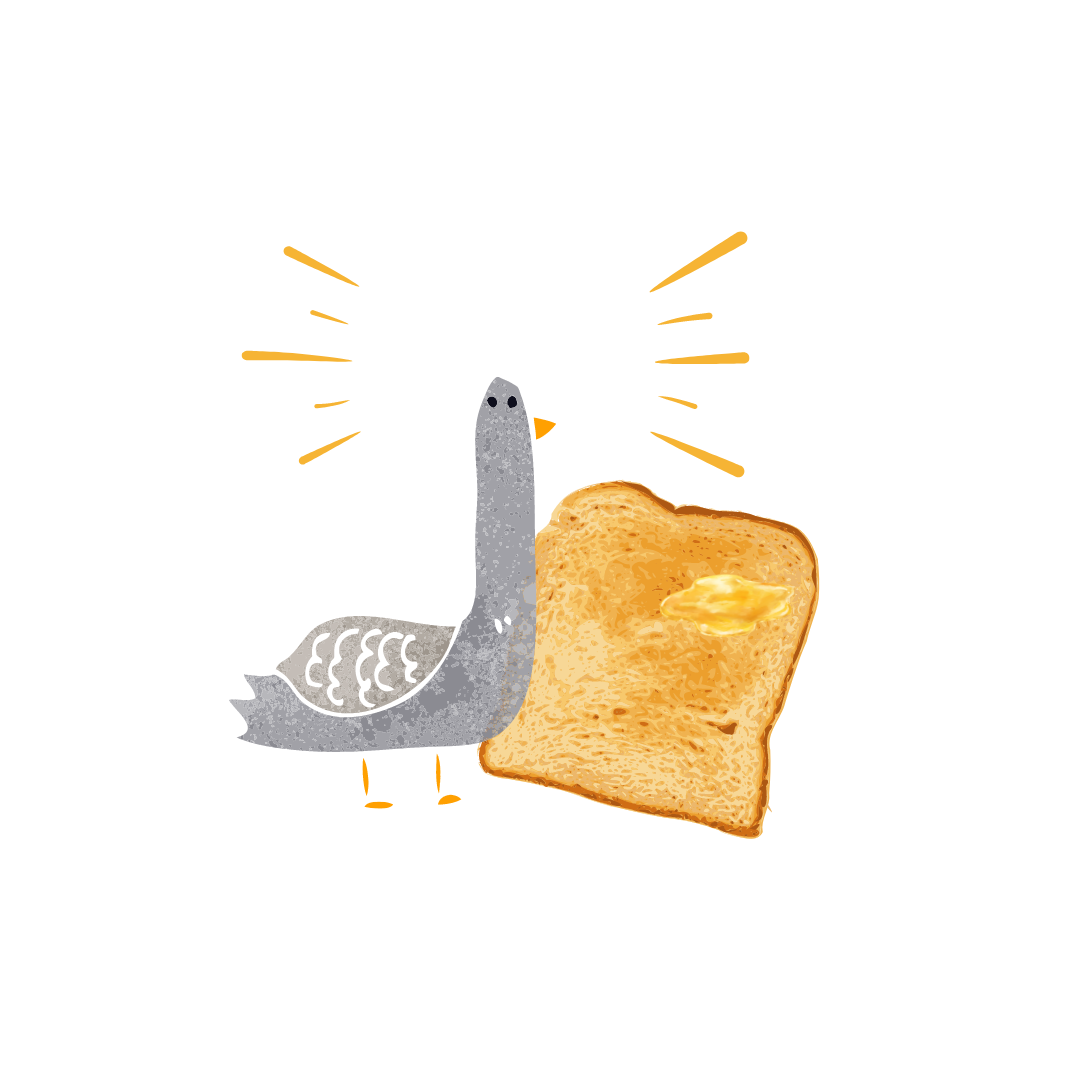
But pigeons are only pigeons because of man’s intervention. We wanted them docile and unafraid. We trained them to be obedient and let them become reliant on us as far back as 5000 years ago. Then, at some point in history, we decided we didn’t want them anymore. Common grey pigeons (closely related to Rock Doves, but not exactly the same bird anymore) have been anomalies ever since—unable to make proper nests or live without close proximity to humans. Does this mean they are not birds? It strikes me as unfair that we blame them for everything that they are, when it was us who created them.

Soft, white, processed bread might be the enemy of so many diets, but it only exists because we wanted it. Correction: we want it. According to UK Flour Millers, Nearly 11 million loaves are sold every single day in the UK, and wrapped and sliced bread accounts for 85% of UK bread production. Sliced bread is everywhere because of us, and I think that’s rare. Usually processed foods are pushed on us through marketing, as additions to our diet we didn’t ask for. Processed bread just exists around us, as something we once hailed as the ultimate convenience, now taken for granted and slightly vilified. Even I find myself feeling guilty when I choose it over a local bakery’s seeded batch. Is that progress or diet culture or something else entirely? What I will say is this: It feels a little unfair to me to have all this wonderful bread around and for all of us to pretend it isn’t as nice as the healthy stuff.

Why do I love Toastie? There are so many reasons.

It is ethereally soft. When you pick the freshest orange packet, it’s like biting into a cloud.

Making toast with it makes the whole house smell like a delicious bakery.

Dry Toastie toast is the approved post-sickness test food to see if you feel well enough for the next step—tinned tomato soup.

It is always there for me. No matter when I get back from being away, or how unreasonable my brain is being, or how lazy my day is, there is a squishy, freshly-baked loaf of Toastie waiting for me at the shop.

If you roll it flat, brush it with olive oil, sprinkle salt on and toast it under the grill, it becomes instant crackers for a makeshift cheeseboard.

My grandad’s house smelled of toast, and curry powder. He lived off curries and occasionally goulash, or pea and ham soup simmered until it was the colour of army issue fatigues. I don’t think he ate toast himself, he would just make sure there was Toastie and marge in the house for when we went round to stay, a small but meaningful act of service. Even now, the smell reminds me of him—strange, since as I say, this was not a food he ate. He drank John Smiths and loved a Dopiaza. I love you grandad. Thanks for the toast.

Zingibeer: Dublin Spice

Dublin’s other perfect pint

I learned a lot on my trip to Dublin last weekend.

I learned that I can travel by plane now without a thousand rituals and a meltdown. I can just walk on board and sit down. I even slept.

I learned that time moves differently in the Irish National Gallery. Three hours passed like ten glorious minutes, as my skin absorbed the colours and brushstrokes. I learned I miss art galleries with an aching heart.

I learned while I stared at the beauty of St Stephen’s Green’s icy pond that while I live in the middle of the Lancashire countryside, I am starved of picturesque, landscaped green spaces. I learned that herons sit in trees and watch you watch them.

I learned that in Dublin, incredibly dressed manikins step out of Quality Street tins in immaculate shop window displays, metallic material folded, twisted, and wrapped like sweets.

I also learned that Guinness is not the only fruit. Sure, of course I drank my fair share and then some of Dublin-brewed Guinness. How could I not? But I was introduced to something truly revolutionary that might have changed my perspective on Dublin forever. Have you ever tried Zingibeer?

Katie Mather’s The Gulp is a reader-supported publication. To receive new posts and support my work, consider becoming a free or paid subscriber.

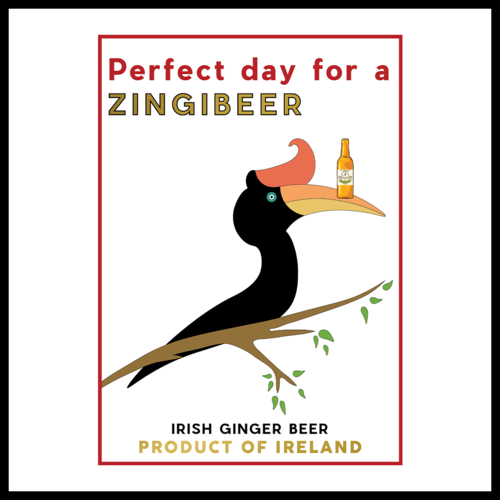
Brewed in Smithfield, on the north side of the Liffey, by a father and daughter team, Zingibeer is a fully-fermented ginger beer. Unlike the other famous pint around town, it’s totally clear. You’d be forgiven for thinking you’d been handed a pint of soda water with a wedge of lime in it. Rather than a beer with ginger beer added to it, Zingibeer is made as you would make it at home, if you’d ever tried, with a yeast mother and plenty of sugar. Once fermented, botanicals and lemon juice is added. That’s it.

It tastes like the warming ginger of a good hot toddy, like a spoonful of what Mary Poppins gives you when you come in from the rain, like a Masterchef contestant has had a go at making stem ginger fizzy cola bottles. It tastes elegant, like the way I wish Porsecco actually tasted—aromatic and just-sweet-enough and a little bit fiery. Moreish. And it’s served on draft so you can get a really satisfying gulp of it in one go, allowing your whole chest to light up with the peppery, golden glow.

I swear I didn’t believe it was alcoholic until I was dancing my arse off at a CMAT gig later in the evening. Zingibeer facilitated the most authentically Dublin experience I think I’ve ever had.

Other Stuff

My Stuff

  • Let me tell you a story. This week on the Pellicle podcast I read my Burger Van piece aloud.

  • I joined Beerlonging for their latest podcast episode, and talked about all sorts, from getting into beer writing, to running and then closing Corto.

  • Hwaet! zine has come back from the printers and is being sent out right now. I have a piece about witchcraft, women’s work, brewsters, alewives, and beer in it and you can buy a copy here.

  • My PROCESS series continues apace, you can read an excerpt of the latest story, about fizzy pop, here.

  • I’ve set up the chat function on Substack so that we can send ideas to each other and talk about things I’ve mentioned in the newsletters. Sometimes these will be paid subscriber only, and sometimes they will be available to all. Also, comments for each newsletter are now open to paid subs too as a little perk. Don’t hate me, a girl’s gotta eat.

PROCESS 04: Pop

The original snap and the hiss

You can’t have fish and chips without a can of dandelion and burdock. You know that, right? And you can’t have a British childhood without chugging Shandy Bass and pretending you’re pissed.

Fizzy pop is everywhere, all around us all the time. It sponsors some of the largest events in the world, and covers our Anthropocene landscape in branded marketing. Go to the top of Everest, there will be a can of coke. I truly believe that there will be a bidding war between Red Bull, Monster, and Rockstar to become the first item of litter on the Mars human habitat.

When I started tasting wine to revise for my WSET L2 exam, I spent a lot of time tasting Diet Coke to try, once and for all, to figure out what it tastes of. It’s not something anyone really asks questions about. We just drink Coca Cola and it tastes like Coca Cola. Cinnamon is what I get from it. Vanilla and cinnamon, and other woody spices, and maybe some weak botanicals. I prefer Diet Coke to regular Coke (and I hate when it’s called “full fat coke” for some reason,

The content below was originally paywalled.

makes me think of scummy bits of oil on the top of a washing up bowl) because regular Coke is so overwhelmingly cloying. The idea of the drink, it seems, is to get as much sugar down you as possible without it coming back up again. I was told once that’s why it’s also acidic. I’m not sure if that’s true. To tell you the truth, I actually prefer Pepsi Max above all. A definite hangover from being a 90s child and saving up tokens and pink ring pulls to send off for exclusive Spice Girls single “Move Over (Generation Next).”

Fizzy drinks as we know them today are almost completely unrecognisable from the tonics and beverages they mutated from. Coca Cola itself was invented in 1886 during a boom-time for wellness tonics in the USA, it’s high sugar content and other no-longer-legal ingredients offering vitality, strong nerves, and as a cure for headaches. It was initially alcoholic, but became a soft drink during prohibition—useful for clandestine drinkers who needed something sweet and palatable to mix their bootlegged whiskey with.

Before Coke became a global monolith, pop in the US was drinks like ginger beer, root beer, and sarsaparilla, which could be made at home with roots and ingredients from the garden, such as birch bark and sap, liquorice, dandelion roots, spruce, and spices like allspice, cloves, nutmeg and cinnamon. The most realistic and widely-available ancestor of these original recipes is Dr. Pepper—its name offering, once again, a look at a time when fizzy pop was seen as a tasty way to keep fit. Then, in the 1960s, the the United States Food and Drug Administration banned the use of sassafras due to a chemical called “saffrol” being present, which when used in extremely high doses can be carcinogenic. “Nutmeg, cinnamon, and basil also contain safrole, but that was not an issue,” notes the American Homebrewers’ Association rather sardonically. During the 1950s, Coke has become something of a fashion statement—now, it was the norm.

In the UK, we had a similar trajectory for our own pop. Vimto, Irn Bru, Tizer, Lucozade, and even Dandelion and Burdock are all drinks that were once energy-giving tonics or alcohol-free alternatives for hard working people. Vimto is just a shortened version of it’s original name “Vim Tonic”, and it was invented by a Blackburn-born herb and spice merchant to make the most of the Temperance movement. Tizer was an alcohol-free aperitif invented in the 1920s in Manchester. Lucozade was invented by a pharmacist in Newcastle as a glucose-rich energy drink for the sick—which is why there is a deep generational need for original, glass bottle, red Lucozade when you’re relegated to your sick bed. Mysterious, orange Irn Bru outsells Coca Cola in Scotland every single year, and nobody really knows what’s in it or what it tastes like. Dandelion and Burdock has been drank in Britain since Medieval times, but the first carbonated and commercially-available bottled version was made by Shaws of Huddersfield in 1871. It’s probably the closest thing we have in the UK to sarsaparilla.

One of the only things I miss about living in a city is the ludicrous amount of choice in every paper shop. I miss KA Black Cherry, and non-standard Fanta flavours, and bottles of off-brand Red Kola. After school I loved a bottle of Moray Cup—I’m pretty sure it was supposed to taste like Pimms or Sangria and I think it was only really available in Aberdeen—and blue Panda Pops were the true enemy of the state. The only drink I ever wanted on a Saturday after dance class. The sugar tax has changed the landscape of fizzy drinks in this country, forcing recipes to change and drinks companies to discontinue flavours, but my memories will remain. Hurray for sickly sweet Barr’s Pineapple. May you hang on to your niche corner of the market for as long as I’m alive.